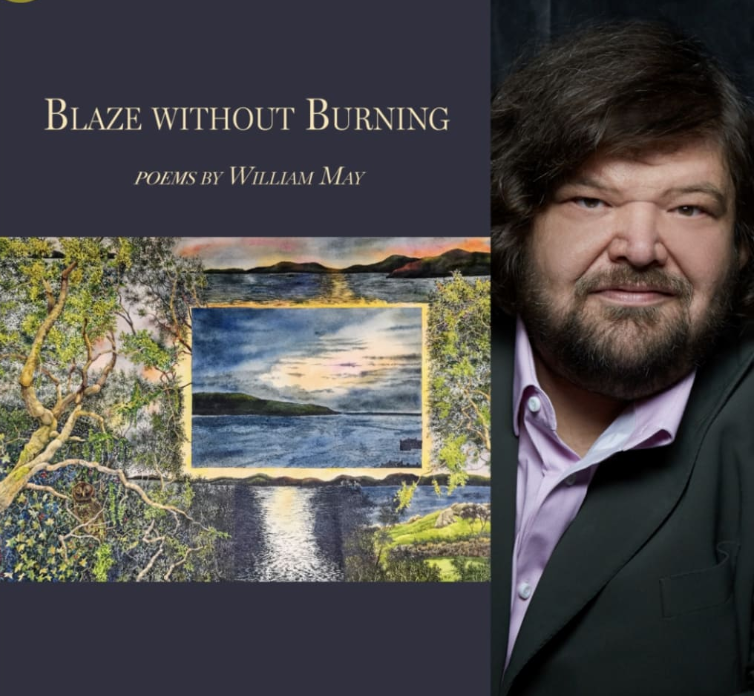
There’s a distinct moment in reading William May’s Blaze Without Burning when you realize you’re not simply engaging with poetry—you’re stepping into a parallel dialogue of perception and possibility. Released May 30, 2025, via Finishing Line Press, this debut chapbook defies linearity, both in structure and in spirit, and introduces May as a poet unafraid to flip the lens and redefine how we encounter the written word.
What sets this book apart from the usual debut fare is its daring architectural blueprint. Blaze Without Burning unfolds in a mirrored format—each poem in the first half finds a companion in the second, bearing the same title but rendered through a different lens. These poem pairs don’t answer each other so much as they complicate one another, revealing how memory refracts over time. There’s no tidy symmetry here—just a mosaic of perspectives, where every emotional beat carries a counter-rhythm.
At the core of May’s work is a defiant kind of transformation. Diagnosed as neurodiverse at seven, May once believed reading would never be within reach. He’s been open about the frustration and alienation of his early struggles with language. But that journey—from feeling intellectually invisible to finding a home in language—infuses every page of Blaze Without Burning with urgency and tenderness. His poetry becomes a reclamation, not just of words, but of self.
May doesn’t traffic in sentimentality—his writing is sharp, lucid, and full of friction. Each line strikes like a spark, not to destroy, but to illuminate. There’s alchemy in these verses, as if language itself is being tested for its tensile strength. His poems often hover in that in-between space—between memory and myth, intimacy and estrangement, stillness and shift.
The title alone—Blaze Without Burning—suggests a kind of emotional alchemy: to feel fully without being consumed. And that’s exactly what May achieves here. His work doesn’t flinch from pain, but it also doesn’t wallow. Instead, it radiates the kind of heat that comes from surviving the fire and choosing to build something out of its remnants.
The visual aesthetic of the collection complements this ethos. The cover art—a watercolor piece by the late Richard Frank—evokes a dream-state grounded in the natural world, adding a visual echo to May’s themes of reinvention and perception. It’s a perfect match for a book concerned with what lies just beneath the surface of things.
A fourth-generation New Yorker raised in the heart of Greenwich Village, May began writing poetry at age nine while attending The Stephen Gaynor School, a trailblazer in individualized education. That formative environment nurtured his creative voice and eventually led him through the halls of the Collegiate School, Sarah Lawrence College, and UNC’s esteemed MFA program. Along the way, his work has appeared in SoFloPoJo, The Centifictionist, and Chameleon Chimera, among others, and his podcast Argh! Not Another Book Publishing Podcast continues to explore the messy, vibrant world of independent literature.
This is not a quiet debut. Blaze Without Burning demands attention, invites revisitation, and rewards reflection. Its recursive design asks you not just to read, but to reread, to engage, to reconsider. Few collections offer that kind of relationship with the reader—fewer still execute it with such emotional precision.
As anticipation builds toward the release, with preorders open through April 4, this chapbook is already carving out its own space in contemporary poetry. Whether you’re drawn in by its formal innovation or its emotional rawness, Blaze Without Burning marks the emergence of a vital new literary voice.
Because in the end, William May’s work reminds us of a powerful truth: fire can be endured. It can even be beautiful. And sometimes, what survives it doesn’t just speak—it sings.
 Cool Happy Genius Heroes