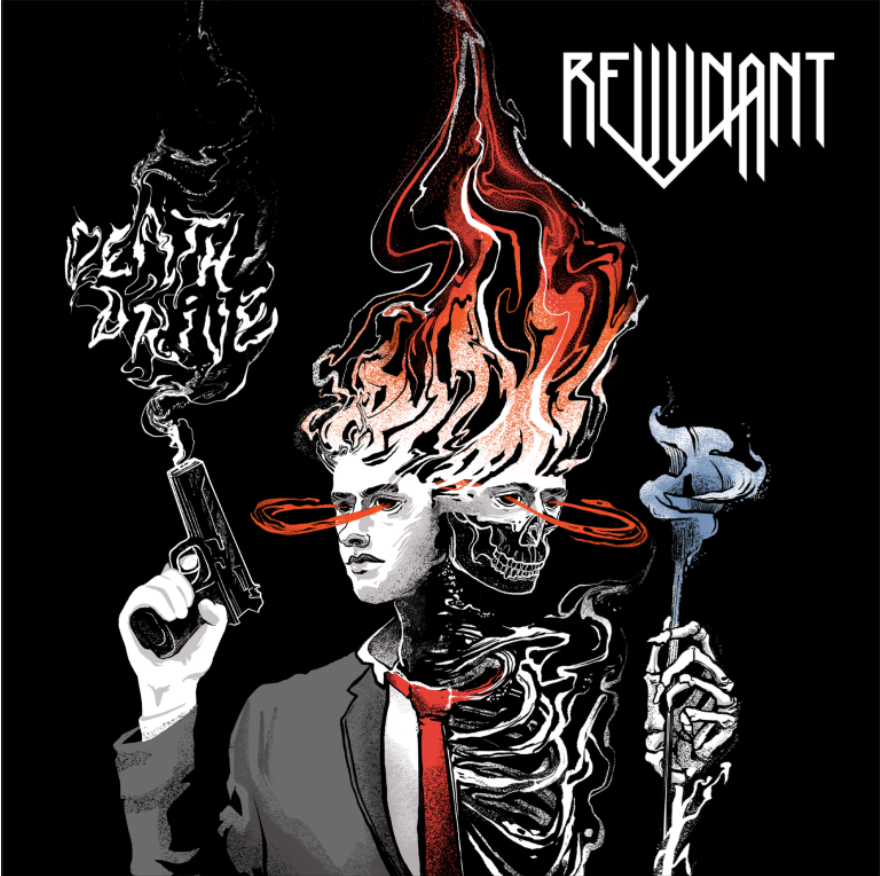
There’s an unmistakable tension that takes hold the moment Death Drive begins. This isn’t an album that eases you in—it pulls you headfirst into its storm, confronting human fragility, political decay, and the self-destructive impulses we can’t seem to shake.
Revvnant, the vision of Elias Schutzman, makes no apologies for the weight it carries. This is music that challenges, unsettles, and, despite its intensity, still manages to seduce with moments of unexpected beauty.
Schutzman has crafted a record where each track feels like its own universe. “Death Cult” ignites the album with fire and venom, a fierce denunciation of Christian Nationalism that leaves no doubt about the tone. “Horror” channels that rage into a pulse-pounding call to resist creeping fascism. Then there’s “Rise,” arguably the emotional heart of the album, with mournful piano chords and swirling synths that unfold like a slow-motion disaster, echoing the real-time collapse of our climate.
But Death Drive is not solely a record of fury. “Alien World” captures the disorientation of living through a global pandemic, caught between alienation and eerie familiarity. “Neukölln” drifts dreamlike, balancing the weight of depression against the thrill of wanderlust. “Rusted Hearts” and “Damascus” expand the lens, documenting addiction, urban poverty, and relentless cycles of violence. The closing track, “Into the Grey,” channels awe and dread through a vast, mountainous soundscape that is both terrifying and transcendent.
Written largely in isolation—first in Berlin in 2018, then during the Covid lockdown at his father’s home in Baltimore—the album bears the mark of intensely personal reflection. Yet Schutzman never fully retreats into himself. Guest musicians add depth and color, weaving guitar, bass, drums, and harmonies into the record’s fabric. Vocals were recorded by J. Robbins at Baltimore’s Magpie Cage Studio, who also handled the mix, while Paul Logus’s mastering gave the album its sharp-edged clarity.
Genre boundaries blur across Death Drive. Industrial shadows, doom-laden weight, trip-hop grooves, and dream-pop shimmer collide and dissolve into one another. The result is an album that is never static, always oscillating between beauty and chaos, hope and despair.
“The underlying theme of this album is in the title—human nature’s fundamental drive toward self-destruction. I let all of my influences bleed together until they stew into something I hope resembles originality. It’s who I am musically, and I can’t hide it.”
Death Drive is not for casual listening. It is dense, heavy, and meant to be absorbed, not skimmed. For those willing to venture into its shadowed corridors, it offers a rare vision—an album that doesn’t just reflect the chaos of the world, but forces you to sit with it.
 Cool Happy Genius Heroes