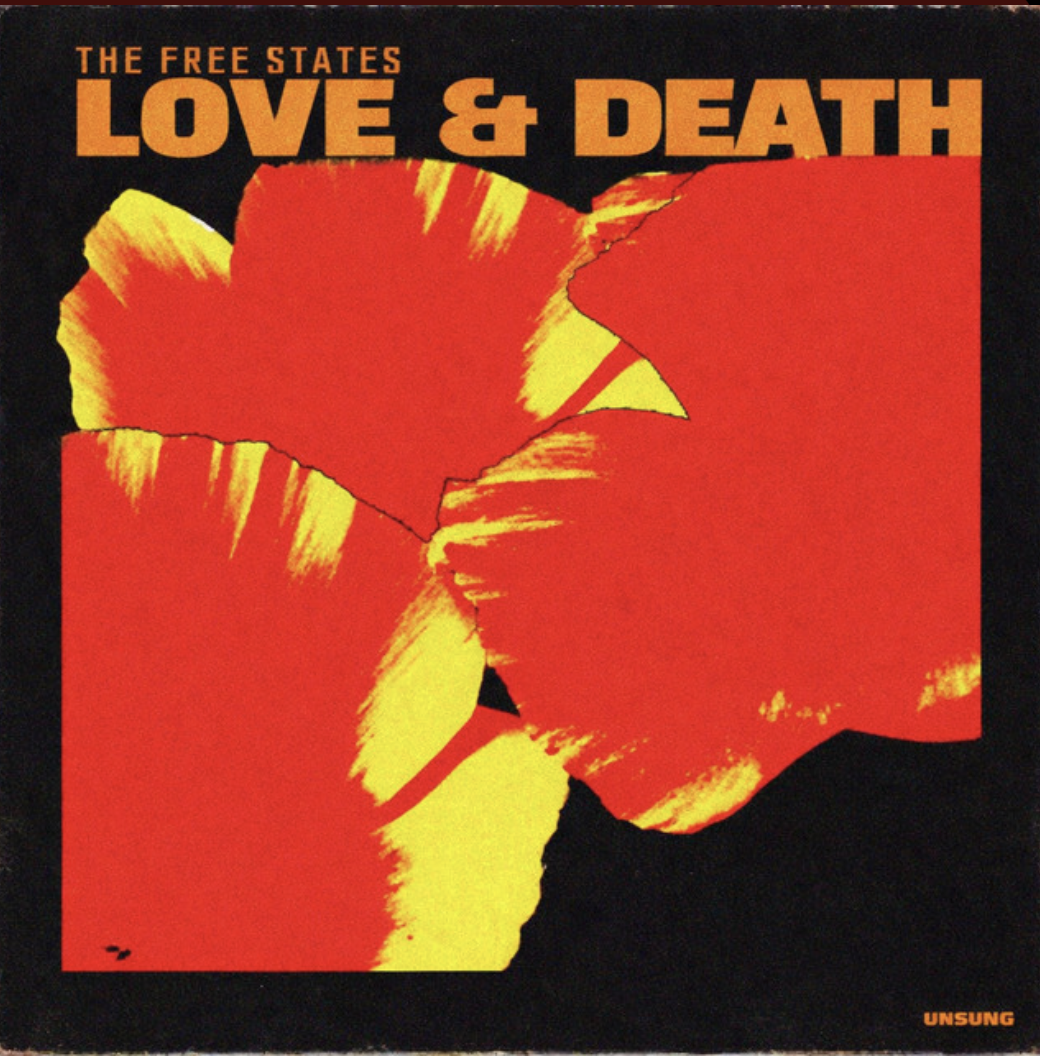
There is something quietly radical about Love & Death, the new album from The Free States, the project of American songwriter Shaun Lyons. Released August 15, 2026, the album is the third Free States record in three years, but it doesn’t feel like a project built around a release schedule. It feels lived in.
Based in Athens, Greece, Lyons has spent much of his life making music in unconventional circumstances. He started playing guitar at fifteen and spent his early years around Gainesville, Florida, but what drew him most was never necessarily the stage. It was the recording process itself: taking pieces of an idea and slowly turning them into a finished song, often alone, long after everyone else had gone home. After stepping away from live music, joining the Peace Corps, moving to Ukraine and later surviving stage four cancer, Lyons eventually found his way back to performing. Three albums followed.
Love & Death is the quieter of the three.
Where 2025’s self-titled The Free States leaned heavily into guitars, Love & Death opens up more space. The arrangements are less traditional, the rhythms are often unexpected, and there is a looseness to the album that allows its songs to move in directions that aren’t immediately obvious. Lyons draws from a remarkably wide musical palette, including Marvin Gaye, Radiohead and Van Morrison, along with Aretha Franklin, Fela Kuti, The Clash, Adult Jazz, Bombay Bicycle Club and Noah and the Whale. Rather than sounding like a collection of references, though, those influences seem to exist somewhere beneath the surface, informing the way the songs move without dictating where they go.
“Definite” is a good example. Written in 7/4, the song captures the uncertainty of being stuck at a decisive point in a relationship. Lyons, who teaches English, brings the idea of definite versus indefinite into the song without making it feel academic. The rhythm gives the track an unsettled quality that matches its subject, while the chorus, taken from an older Shaun Lyons song, gives it a sense of history. Vlad Lomadze’s drumming is particularly striking, providing a restless pulse beneath the song’s melodic structure. The outro may accidentally remind listeners of a familiar European pop song, but the resemblance feels more like an intriguing coincidence than a distraction.
“Most of All” is more intimate. Written at 3 a.m. with an electric guitar sitting nearby and an amp still on, the song is about longing and being pulled in different directions. The strings, refrain and guitar solo make it one of the clearest departures from the more conventional songwriting structures of the previous Free States album. Vitaliy Fesenko’s strings add an emotional dimension without overwhelming the song, giving it the feeling of something discovered rather than heavily constructed.
Then there is “Man the Baddies,” which may be the album’s most revealing track. It began as a pro-war song, became an anti-war song, and eventually turned into something more personal: an attempt to look directly at death and decide what you believe is worth doing anyway. It’s energetic, strange and rhythmically adventurous, characteristics that describe much of Love & Death. The song also captures the album’s willingness to let an idea change as it develops rather than forcing it into a predetermined shape.
“The Eyes Are All You Know” is similarly slippery. It initially sounds like a song about infidelity, but there is another interpretation lurking underneath, one that recalls Robert Frost’s famous meditation on choosing between paths. Whatever direction you take, regret can follow. Or perhaps it doesn’t. The uncertainty is part of the appeal. Even the guitar solo is deliberately simple, fitting the song rather than trying to announce itself.
There is also a subtle rhythmic and almost Indian influence running through the album, adding another layer to its already unusual musical vocabulary. For a record described as the quieter Free States album, Love & Death can actually get surprisingly heavy. That contrast works. Lyons isn’t interested in keeping the listener in one emotional or stylistic place for too long.
What ultimately holds the album together is its handmade quality. Love & Death was created largely on a MacBook, without AI, and with collaborators brought in where they could genuinely contribute something to the songs. That approach fits Lyons’s larger philosophy that the album, rather than the individual song, is the real unit of musical work. At roughly thirty to forty minutes, Love & Death is compact enough to absorb in one sitting but varied enough to reward another listen.
In an era when records can feel engineered around playlists, singles and algorithms, there is something refreshing about an artist still thinking in terms of an album as a complete piece of work. Love & Death doesn’t chase a single sound, and it doesn’t always make its intentions immediately clear. Instead, it asks the listener to follow along.
That makes it an album worth sitting with. The Free States may have started as a way for Lyons to make music away from the pressures of the stage, but Love & Death sounds like the work of someone who has discovered that there is still plenty left to say once the noise falls away.

