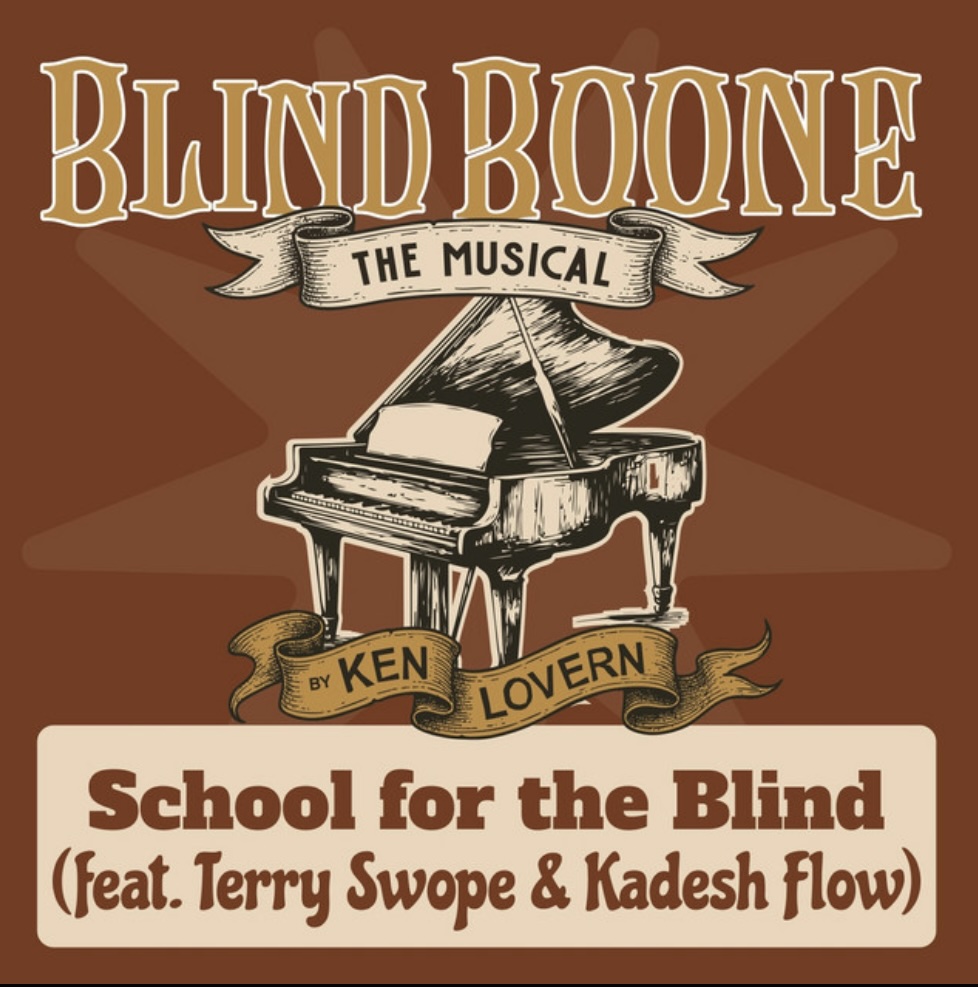
Ken Lovern’s third single from Blind Boone the Musical explores the place where extraordinary talent begins to find its voice.
Talent is rarely born fully formed. It arrives quietly, sometimes before we have the language to understand it. A child discovers an instrument, a sound, a rhythm that feels somehow instinctive. Someone notices. A teacher listens. A door opens. What happens next can change the course of a life.
For John William “Blind” Boone, one of America’s great musical pioneers, that door was the Missouri School for the Blind.
It is here that “School for the Blind,” the third single from Kansas City composer and jazz organist Ken Lovern’s Blind Boone the Musical, takes us. After the journey towards freedom explored in “Quindaro,” the story moves inward. The landscape changes from roads and rivers to classrooms and instruments, from survival to discovery. Boone is still a boy, but the extraordinary musician he will become is beginning to emerge.
There is something moving about telling a story from this point of view. We already know what Boone will become. We know about the tours, the packed concert halls, the astonishing musical memory and the ability to hear a composition once and return it to an audience as something transformed. But none of that has happened yet. Here, there is simply a young musician discovering what he can do.
And perhaps that is where the real magic lies.
A school is more than a building. At its best, it is a place where possibility is recognised before the person understands what it means. For Boone, education provided not only knowledge but an environment in which his extraordinary relationship with music could develop. His blindness did not define the limits of his world. Music expanded his other senses.
Lovern captures that sense of possibility beautifully. The music moves freely between jazz, gospel, blues, classical influences and contemporary sounds. That is increasingly becoming one of the most compelling aspects of Blind Boone the Musical. Lovern isn’t trying to place Boone behind glass. He is bringing him into the present.
Terry Swope provides vocals and guitar, bringing an earthy warmth to the recording that suits this chapter of Boone’s story. Kadesh Flow returns with another distinctive contribution, adding his voice as rapper and trombonist to Lovern’s increasingly eclectic musical vocabulary. His presence reinforces the idea that history does not belong exclusively to the past. The music of one generation can become the language through which another generation discovers it.
That cross-generational conversation is at the heart of the project. Lovern himself comes from a musical life built on experience rather than boundaries. A longtime Kansas City jazz organist and composer, he spent more than thirteen years performing with his Organ Jazz Trio at the Green Lady Lounge, absorbing the lessons that only thousands of hours in front of a live audience can teach. That instinct for rhythm, arrangement and musical communication is evident here, but so is something else: a deep belief that music should make us feel the story rather than simply hear it.
“School for the Blind” is therefore about more than an institution. It is about the first place where a possibility begins to feel real.
We all have versions of that moment. A teacher who sees something in us. A room where we discover an ability we didn’t know we possessed. A piece of music that changes the way we hear everything afterwards. The places that shape us are often ordinary while we are inside them. It is only later that we understand how important they were.
For Boone, the Missouri School for the Blind was one of those places.
Blind Boone the Musical is gradually revealing his life in much the same way that a person comes to understand their own past, not as a single grand narrative, but as a collection of moments, people and places that gradually become connected.
“School for the Blind” gives us the beginning of the voice. For now, there is a young boy, a piano, a room full of possibility and the first hints of something extraordinary waiting to be heard.
Keep up with Ken Lovern and Blind Boone the Musical on the Website
 Cool Happy Genius Heroes