Some songs seem to contain an entire landscape within them. You can hear the weather changing, feel the distance between two people, sense the passing of time, all without the songwriter ever having to explain exactly what it means. Modest Mouse’s “Ocean Breathes Salty” has always had that quality, its deceptively simple melody carrying thoughts about mortality, memory and what remains when the people we love are no longer within reach.
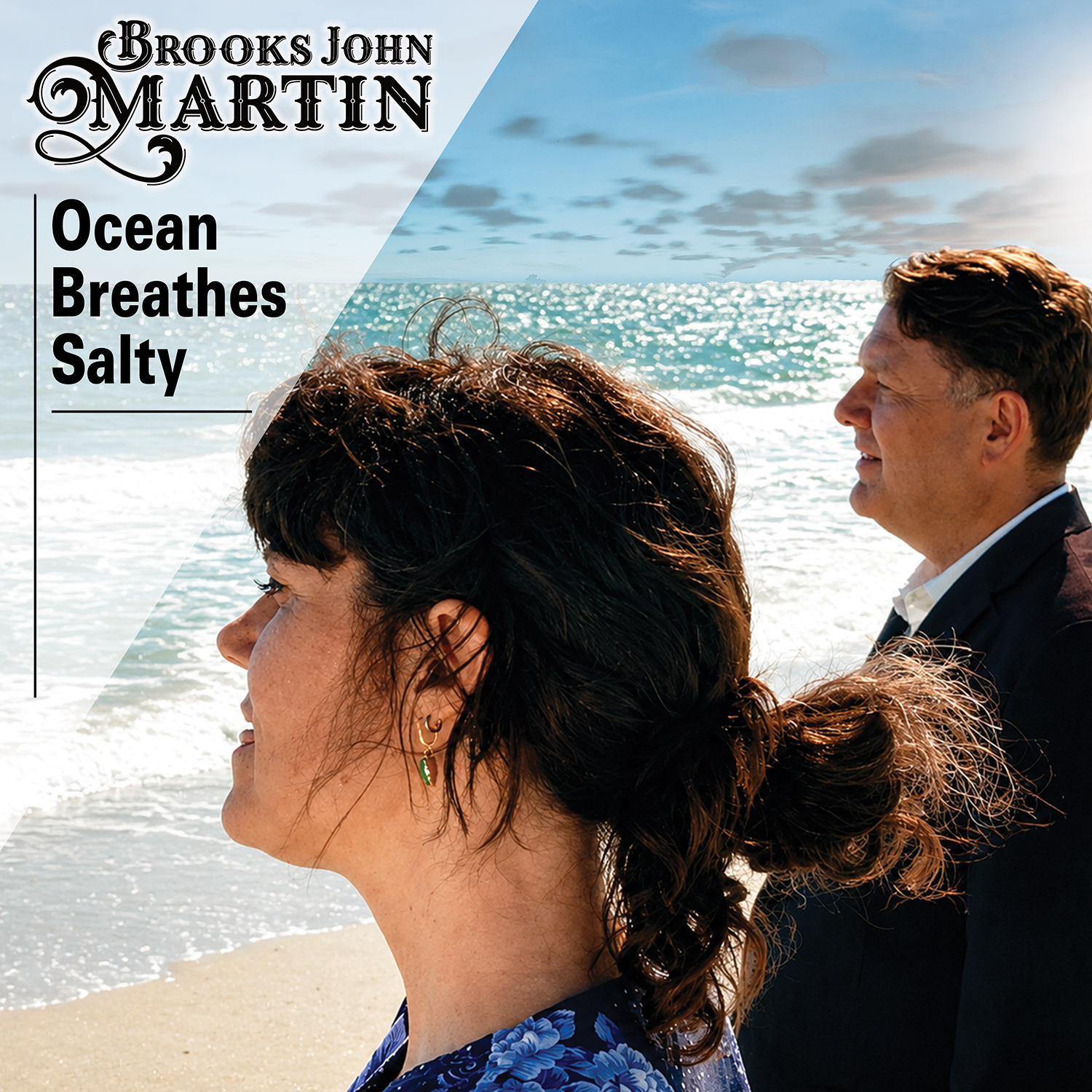
Brooks John Martin clearly hears something in that emotional ambiguity. His new version, featuring Lilly Hiatt, takes the Modest Mouse song and slows the pulse, opens the windows and lets a little more air into the room. Inspired in part by Mark Kozelek’s Sun Kil Moon interpretation, Martin’s arrangement is spacious, with his deep baritone and Hiatt’s more vulnerable vocal occupying opposite sides of the same emotional landscape.
Martin has always been interested in what happens when familiar songs are taken apart and rebuilt according to a different set of instincts. There is an understated country feel beneath the arrangement, while the open-C# guitar tuning gives the track an unusual resonance, allowing individual notes to hang in the air rather than simply filling the gaps between the vocals.
“I chose the song because Ive always been a big Mark Kozalek fan and this is one of my favorites,” Martin explains. “I love the guitar tuning in open C#. I imagined doing a version as a duet with some sparse drums. We found Lilly on the internet and knew she’d be a perfect fit for what I wanted to do.”
And she is. Hiatt brings exactly the kind of longing female voice Martin imagined when he first heard the song in his head. Her voice has a grain and warmth that works beautifully against his lower register, creating the feeling of two people looking at the same memory from different distances. There is no vocal grandstanding here, thankfully. The chemistry comes from the contrast.
It is also where Martin’s affection for Kozelek becomes interesting. He has followed his work from Red House Painters through Sun Kil Moon, and clearly regards his music as something more substantial than simple influence. There is an authenticity in Kozelek’s approach that Martin wanted to honour, while still allowing his own fascination with country, classical music and cinematic arrangement to reshape the song.
There is a sadness running through, certainly, but also something warm and strangely comforting. Martin’s baritone gives the song an almost weathered quality, while Hiatt brings a lighter, more fragile presence. Together they create a version that feels less like a cover and more like somebody has opened a door into another room and discovered the same song living there under different light.
The video, filmed at Oak Island Beach in North Carolina, seems like the natural visual companion. There is something almost comically straightforward about taking a song concerned with the vast questions of existence and putting two musicians on a beach, but perhaps that is exactly the point. The ocean has been contemplating these things considerably longer than we have.
Martin noticed the contrast while filming. Curious beachgoers wandered past the cameras hoping, perhaps, that somebody famous might be hiding behind the production. Meanwhile, the birds carried on defending their territory and hunting for buried creatures, entirely indifferent to the human drama taking place around them. For a songwriter interested in mortality and memory, there is something wonderfully humbling about that.
It also captures something of Martin himself. Beneath the carefully considered arrangements and his obvious knowledge of composition is a willingness to embrace the ridiculous. He describes himself as a “brutish bear” alongside Hiatt’s “fierce hummingbird”, joking that she has the pedigree while he is “an imposter from Iowa”. There is self-deprecation there, but also a recognition that music allows him to become somebody slightly different from the intensely private person he is away from it.
“Ocean Breathes Salty” is therefore more than an exercise in reinterpreting a familiar song. It is Martin finding the emotional centre of a piece he loves, inviting Lilly Hiatt into it, and then giving the whole thing plenty of space. Out there on the North Carolina coast, with the guitars ringing, two voices meeting somewhere between melancholy and hope, and the birds going about their ancient business, it feels as though the song has found exactly the landscape it was looking for.
Keep up with Brooks John Martin on his Website

