
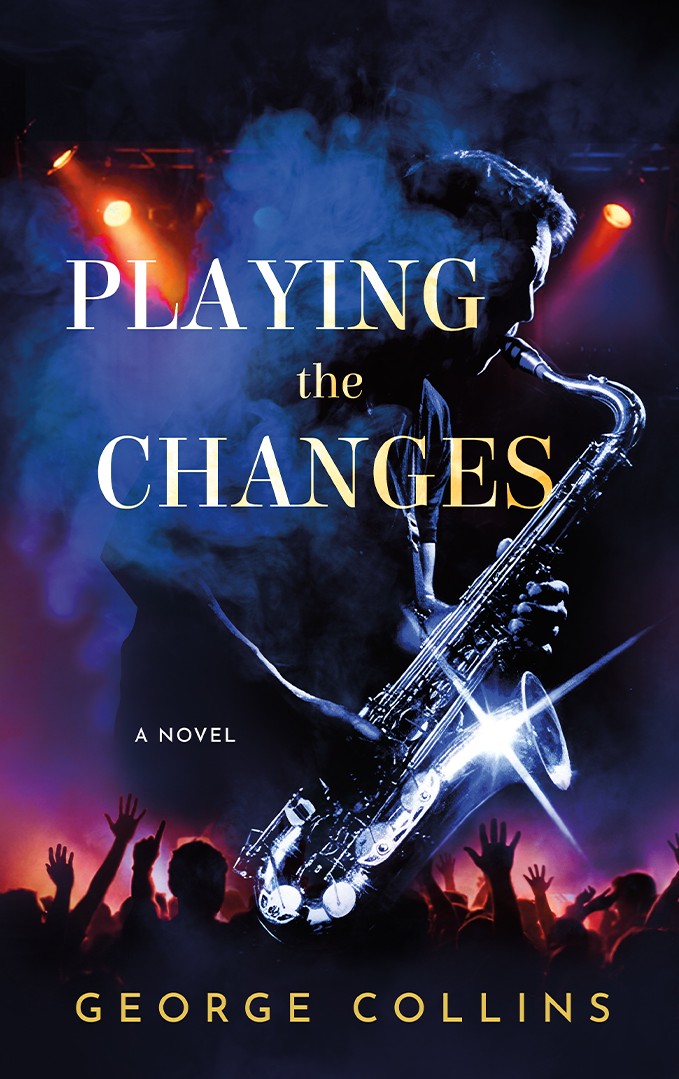
Despite being George Collins’s debut novel, PLAYING THE CHANGES is hardly the sort of book that appeared overnight.
In fact, Collins spent eighteen years getting it from the first idea to the finished novel, during which time he managed a career in international finance, returned seriously to music, released four albums of original material, became a father, researched neurosurgery and jazz to an almost obsessive degree, wrote more than a hundred drafts and eventually adapted the story into a screenplay that has gone on to win several international awards. So while the book may be described as a debut, there is an awful lot of life behind it.
The original idea arrived in perhaps the most appropriate way imaginable for a novel so concerned with music, dreams and transformation. Collins woke up in the middle of the night after dreaming of a man standing beneath blazing stage lights, playing a saxophone with sweat and tears running down his face while a woman watched from a bar, encouraging him. He got out of bed, went to his office and wrote an eight-page treatment containing the essential elements of the story. The strange thing is that the image remained with him for years before eventually becoming the closing point of PLAYING THE CHANGES.
At the centre of the novel is Ray Stark, a highly successful neurosurgeon at Massachusetts General Hospital who is approaching the pinnacle of his professional career. Ray is the sort of man who likes things to make sense. His world is built around intelligence, discipline, control and the reassuring belief that problems can be solved if you understand them well enough. Unfortunately, life has a rather inconvenient habit of refusing to behave according to those rules.
The death of Ray’s young daughter changes everything. What initially looks like a story about grief gradually becomes something much larger, as the loss begins to dismantle the emotional architecture Ray has spent his entire life constructing. His marriage suffers, his career begins to unravel and his psychological stability deteriorates. More importantly, the tragedy forces him to confront parts of himself that he has spent decades avoiding.
That includes his childhood. Ray grew up with an abusive father and an alcoholic mother, learning early that vulnerability was something to fear and emotional distance was a useful form of protection. As an adult, he has convinced himself that he is nothing like his father, yet gradually begins to recognise that emotional withdrawal can inflict its own kind of damage.
The novel is at its most interesting when it explores this uncomfortable territory, because Ray isn’t simply being asked to recover from what happened to him. He has to acknowledge what he has done to other people as well.
This is where the book’s title starts to make considerably more sense.
Music has always been central to George Collins’s own life, and in PLAYING THE CHANGES it becomes the means through which Ray begins to find a way forward. After abandoning the saxophone many years earlier, he rediscovers jazz at a point when virtually every other part of his life has fallen apart. It’s not presented as some convenient magical cure. Ray has to struggle with the instrument, learn again and accept that he cannot simply impose his will upon the music.
His mentor Ozzie gives him perhaps the most important piece of advice in the entire novel: “You gotta learn to listen, man!” It sounds like straightforward musical instruction, but it applies just as directly to Ray’s emotional life. He has spent years talking, deciding, diagnosing, controlling and fixing. Now he has to listen.
And that is essentially what playing the changes requires. Jazz depends upon responding to what is happening rather than simply following a predetermined path. You listen to the other musicians, understand where the music is going and adapt. For Ray, who has spent his life trying to eliminate uncertainty, this is a remarkably difficult lesson.
Collins’s own research into the musical side of the story was extensive. He is a lifelong musician and guitarist, but not a saxophonist, so he immersed himself in books about the instrument and studied transcriptions of classic saxophone solos by players including Coleman Hawkins, John Coltrane, Lester Young and Sonny Rollins. He also accumulated an enormous collection of jazz recordings while writing the novel. That attention to detail matters because music isn’t simply sitting in the background here as atmospheric decoration.
There is inevitably an interesting parallel between Collins and his protagonist, given that Collins himself walked away from a long career in finance and eventually returned to music and writing. But the author is careful not to suggest that Ray is an autobiographical character. Collins describes his own return to creativity as something driven by artistic impulses that resurfaced as he approached fifty, whereas Ray’s reinvention comes after losing his daughter, his marriage and his career. The similarities are therefore more philosophical than biographical: both men discover that the identity they have built around themselves isn’t necessarily the identity they have to keep.
The book also benefits from Collins’s own interest in psychology, philosophy and spirituality. Those ideas aren’t simply bolted onto the story, but form part of the characters’ attempts to understand why their lives have gone wrong and what, if anything, can be done about it. Ray’s journey is about grief and responsibility, while Cathy has her own spiritual and emotional journey. The novel is interested in faith and doubt, control and spontaneity, trust and betrayal, forgiveness, reconciliation and second chances. In other words, most of the things that make being a human being considerably more complicated than being a neurosurgeon.
There is a considerable amount of research behind the medical side, too. Collins spent years reading about the brain and neurosurgery, even taking online courses to ensure that the details were credible.
That may sound slightly excessive until you remember that he was writing about a neurosurgeon while having no professional experience in the field. The same applies to Boston, where the story is set. Collins had visited the area as a boy because his mother’s family came from there, but much of the research for the setting was carried out online before he eventually returned to Boston to check his descriptions and directions.
One of the more unexpected details surrounding the novel is Collins’s connection with Grammy-winning jazz saxophonist Joe Lovano. The two met at a jazz club in Prague and stayed in touch. Collins eventually sent Lovano a work-in-progress copy of the novel, and Lovano not only gave the book his blessing but agreed to appear in its later chapters. Given how important jazz is to Ray’s transformation, it is a particularly fitting connection.
The long gestation of PLAYING THE CHANGES also seems to have changed Collins as a writer. He has a Masters in English Literature and a law degree, and initially assumed that his facility with language would make writing a novel relatively straightforward. He discovered, rather quickly, that creative writing demanded a completely different way of thinking. More than a hundred drafts followed. Earlier versions apparently contained scenes running to twenty-five pages which eventually had to be reduced to a couple. The process of adapting the novel into a screenplay helped Collins identify what was actually essential to each scene, and the finished book is considerably leaner as a result.
That screenplay now has a life of its own, having won several international awards and attracted interest from Hollywood producers. Collins has written the adaptation himself, retaining the major story points while stripping away the interior monologues that belong to the novel rather than the screen. It is easy to see why the story would appeal in that format. A brilliant surgeon losing his professional identity after the death of his daughter, an imploding marriage, childhood trauma, a rediscovered love of jazz and the possibility of redemption gives it plenty to work with. But the novel has the advantage of being able to sit inside Ray’s head in a way that film cannot.
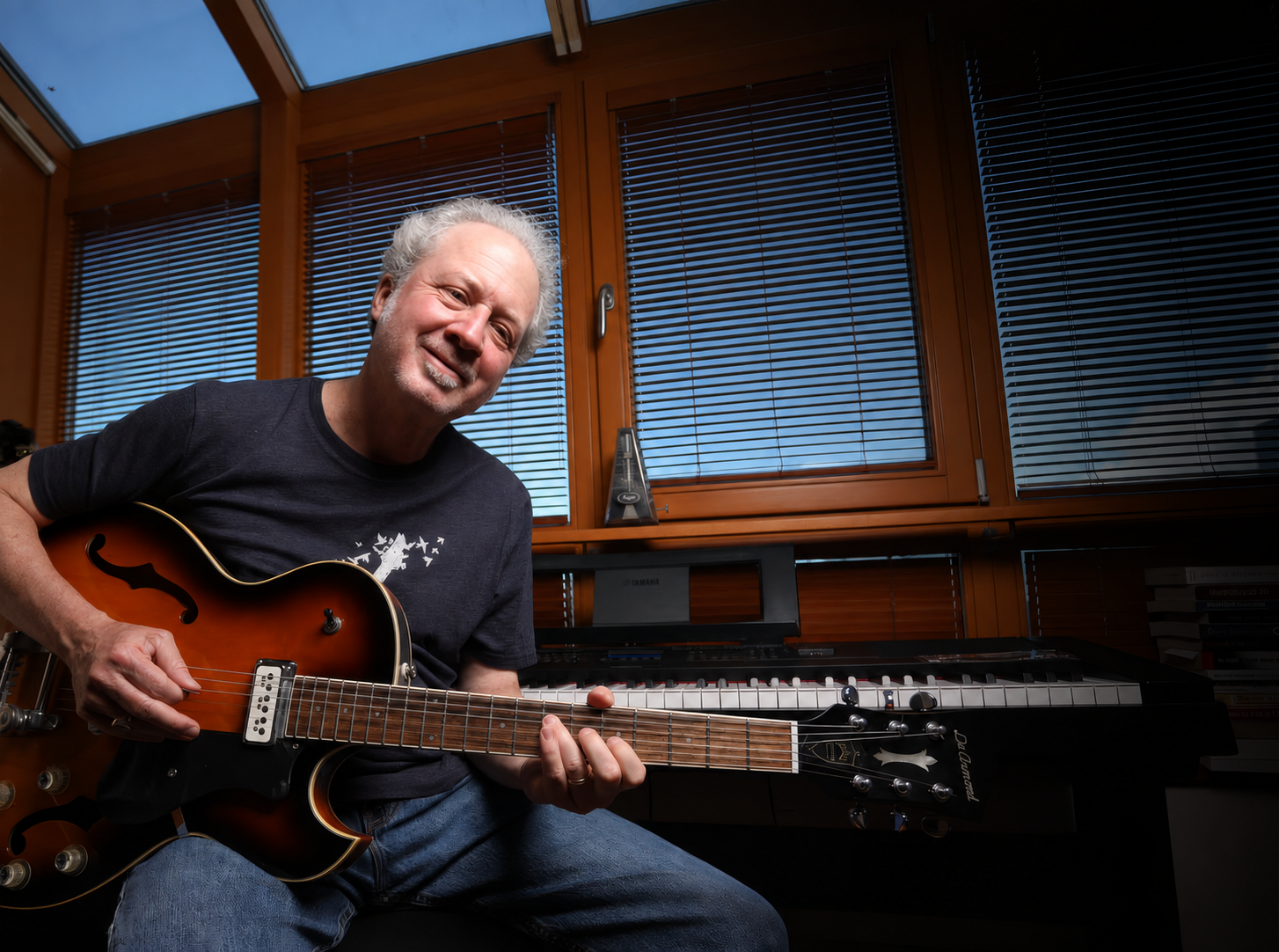
Perhaps the most revealing thing Collins says about the book is also the simplest. Asked what advice he would give aspiring novelists, he answers, “Don’t write what you know – write what you feel.”
That seems to explain PLAYING THE CHANGES rather well. Collins didn’t need to have been a neurosurgeon or to have experienced Ray’s particular tragedy. He needed to understand the emotional questions underneath it. What happens when control stops working? Can a person escape the patterns they learned as a child? How much damage can good intentions hide? And is it really possible to change after years of behaving in the same way?
Collins clearly believes it is. He has said that he would like to think writing the novel made him a more open and empathic person, and that when he catches himself becoming withdrawn or difficult with his family, he can recognise the warning sign and remind himself, “Don’t be like Ray!”
Ultimately, PLAYING THE CHANGES is a novel about a man who has spent most of his life believing that the answer to everything is to become better at controlling it. Grief teaches him otherwise. Music teaches him something else: that sometimes you have to listen, respond, take a risk and accept that you don’t know exactly where the next note is going.
For a book that began with a dream of a saxophonist playing through sweat and tears beneath a spotlight, it seems entirely appropriate that Ray’s journey eventually comes down to the music.
If stories about grief, reinvention, jazz, damaged families and people discovering that starting over is considerably harder than simply deciding to do it are your kind of thing, PLAYING THE CHANGES is well worth seeking out.
PLAYING THE CHANGES is available to purchase on Amazon and Audible.

